Hip Mobility Pilates: How to Open Tight Hips Safely
Hip Mobility Pilates: How to Open Tight Hips Safely
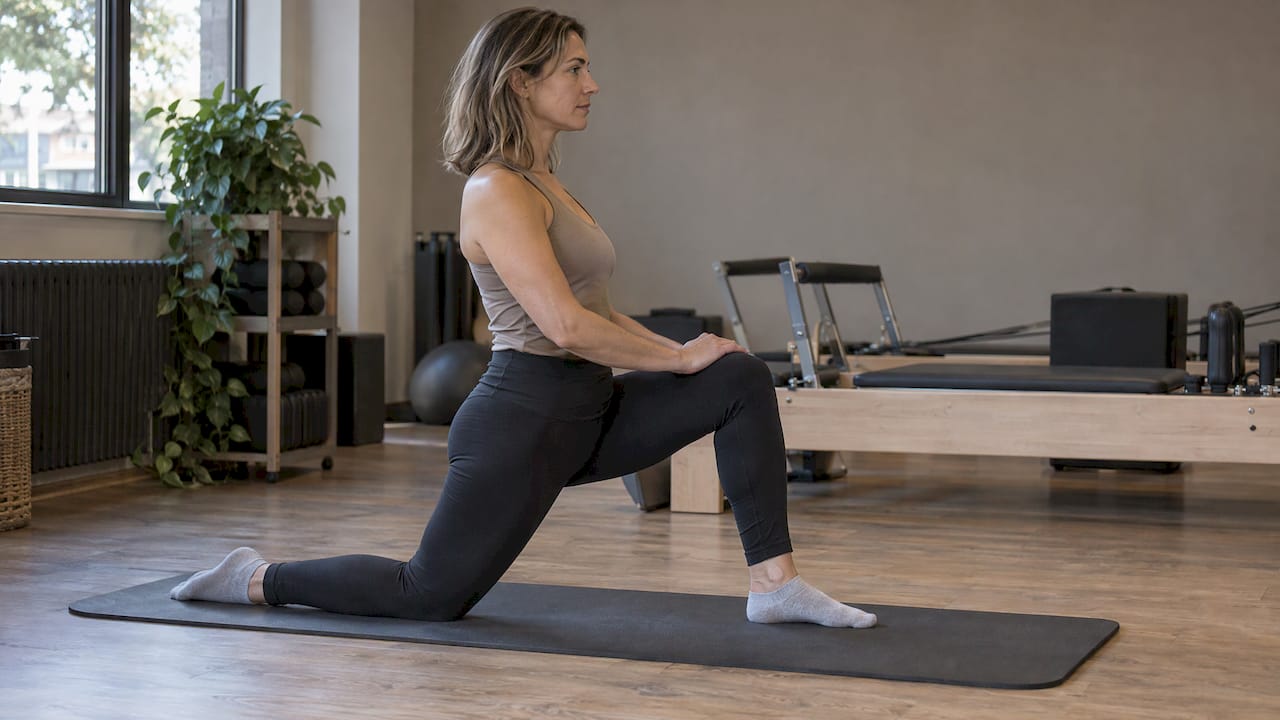
Pilates improves hip mobility because it pairs controlled opening with strength at the end of your range, so the new movement is yours to use and does not fade after a stretch. That is the difference between a hip that feels loose for an hour and one that moves well on the stairs, on the golf course or at your desk. At MTLPILATES, our downtown Montréal studio, hip work is taught on the full apparatus with an instructor who corrects your alignment by hand, which is where most hip mobility problems are actually solved.
TL;DR
- Hips often feel tight because surrounding muscles are guarding a joint that is not well supported, so strength and control matter as much as stretching.
- A good Pilates hip routine combines openers (hip flexor stretch, figure-four, leg circles) with glute and deep-hip work (clams, bridges, side-lying leg lifts).
- Hip structure differs from person to person, so turn-out and range should be matched to you, not copied from a video.
- For flat feet and bunions, Pilates is a way to build hip, leg and foot control alongside your doctor or podiatrist’s care.
- Stop at mild discomfort, never sharp pain. Private sessions at MTLPILATES let an instructor tailor each movement to your body.
Table of Contents
- Why hips feel tight in the first place
- What a Pilates hip mobility routine includes
- Your hips are not built like anyone else’s
- Why the apparatus helps the hips
- Pilates for flat feet
- Pilates for bunions
- How often should you practice?
- Where to start in Montréal
- Our perspective
- FAQ
- Sources
Why hips feel tight in the first place
Tightness is a sensation, not always a short muscle. Pilates Protocols explains that hips often feel tight because muscles are guarding a weakly supported joint. Another Pilates teaching source describes the same chain: underactive glutes make the hip flexors and lower back take over, and the body limits available range to protect that pattern.
That is why long sessions of passive stretching so often disappoint. The stretch is pleasant, then the feeling returns. The Pilates approach is to move through your full available range under control, with deep core stabilization and strength where the movement ends.
There is research that points the same way, with a caution. A 2013 randomized trial of 39 female dance students compared six weeks of strength training, low-intensity stretching and moderate-to-high-intensity stretching. All groups improved passive range, while strength training and low-intensity stretching improved active range more than the harder stretching. It studied dancers, not Pilates, but it supports the idea that usable range comes from strength as well as length.
What a Pilates hip mobility routine includes
A well-built session works through three layers.
- Open. Kneeling hip flexor stretch, supine figure-four, leg circles.
- Stabilize. Clams, glute bridges, side-lying leg lifts, which teach the deep hip and glute muscles to hold the joint.
- Integrate. Hip hinges, 90/90 transitions and quadruped hip circles, which put the new range into movement.
A beginner sequence you can follow
Pilates Protocols gives a 10 to 12 minute beginner sequence for tight hips, done three to four times a week after a short walk:
| Exercise | Dose |
|---|---|
| Kneeling hip flexor stretch (squeeze the glute, tuck the tailbone) | 45 to 60 seconds per side |
| Supine figure-four | 45 to 60 seconds per side |
| Leg circles | 5 in each direction |
| Quadruped hip circles | 5 in each direction |
| Clams | 12 to 15 per side |
| Glute bridge | 10 to 12 reps |
| Side-lying leg lifts | 10 to 12 per side |
| 90/90 transitions | 5, slowly |
| Standing hip hinge | 10 reps |
The same source says most people feel freer within about two weeks and hold the range after six to eight. Treat that as a typical pattern, not a promise.
Safe pacing
Go gently into range and breathe. Cleveland Clinic suggests holding each hip opener for five to eight breaths, and seeing a healthcare provider if you feel sharp, pinpoint pain or pain that lasts more than a few hours. Nova Scotia Health’s hip exercise guide advises moving slowly without bouncing, holding stretches for 30 seconds and stopping at mild discomfort rather than severe pain. If you have had a hip replacement or a recent injury, follow your surgeon’s or physiotherapist’s limits and bring them to your first session.
Your hips are not built like anyone else’s
Videos show one version of each exercise. Your joint may not match it. The Pilates Journal notes that an average hip has about 45 degrees of external and 35 degrees of internal rotation, and that retroverted hips allow more external rotation while anteverted hips allow more internal rotation. A turn-out that feels easy for one person can pinch another.
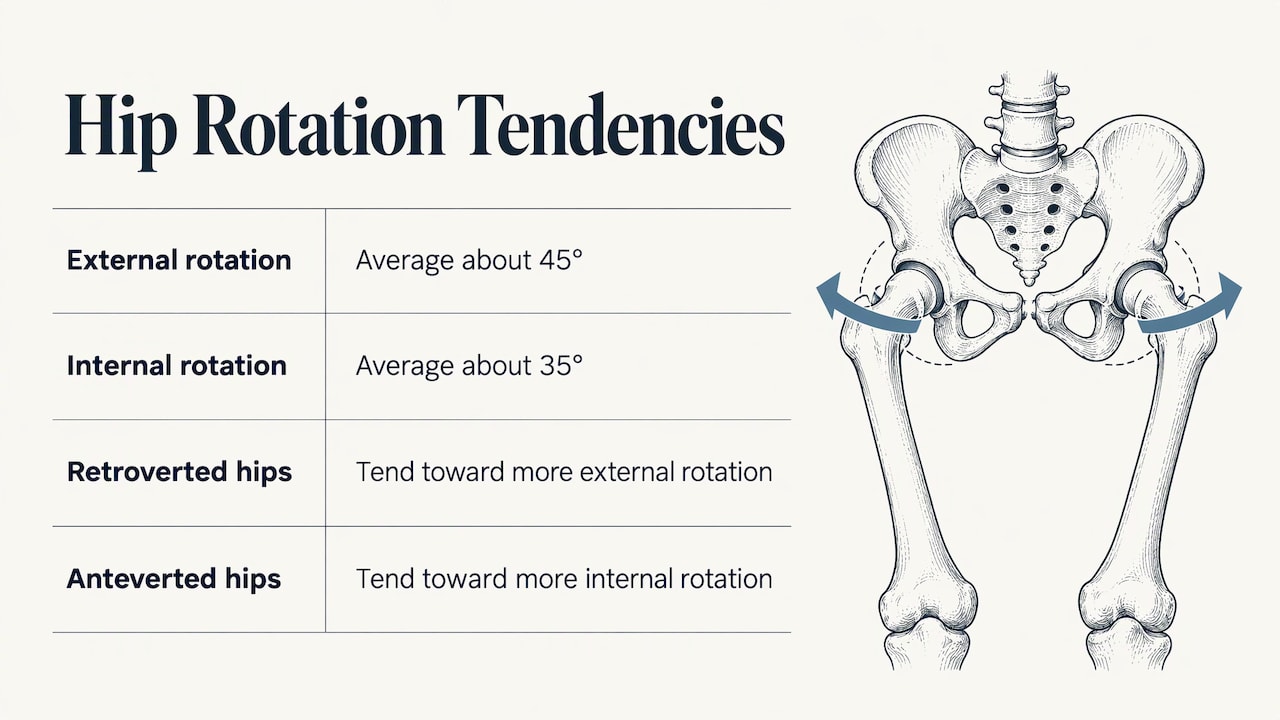
The practical consequence is that the same exercise gets adjusted: smaller leg circles, a different foot position on the carriage, or a parallel stance instead of turn-out. Seeing this takes a trained eye and hands, which is why our instructors, all certified across the full Pilates system, teach with small groups and hands-on correction. In a Reformer class capped at 12 people for 50 minutes, you are seen. If your hips need more individual attention, a private or duo session lets us build the whole hour around you.
Postural and movement assessment is also a skill in its own right; a guide to how a coach assesses posture shows how much can be read from how someone stands before a program is set.
Why the apparatus helps the hips
Springs give feedback that a mat does not. On the Reformer, the carriage supports your legs through leg circles and footwork so the hip can move without the body gripping. The Cadillac, Wunda Chair and Ladder Barrel add other angles for hip flexion, extension and rotation. Our studio teaches the complete system rather than the Reformer alone, so your hip work can progress across equipment as you improve. You can see how we use each piece on our apparatus page.
Pilates for flat feet
Most flat feet are normal and need nothing done. A Human Web’s flat-feet guide notes that no trial has shown Pilates changes the arch or eases flat-foot pain, and it places Pilates as the hip, leg and balance part of the picture next to GP or podiatrist care. If your feet hurt, see your doctor or a podiatrist first.
Where Pilates fits is the chain above the foot. Useful adaptations from the same guide include:
- Pressing through the whole foot, big toe down, in bridges.
- Pointing then flexing the foot at the top of leg circles.
- Clamshells, side kicks, wall side leg lifts and single-leg circles in modest sets.
These strengthen the hips and legs that control how your foot lands, which matters for walking and running.
Pilates for bunions
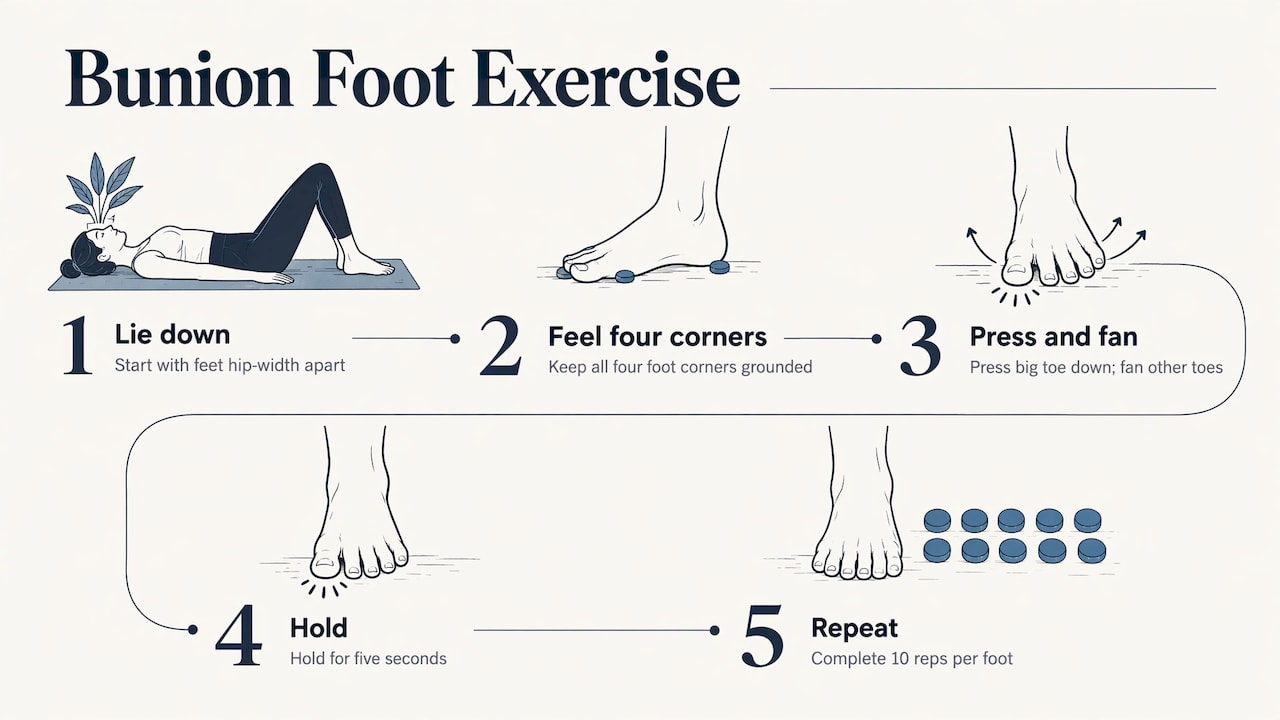
A bunion is a bony bump at the base of the big toe. Pilates cannot remove it, and any pain or deformity should be assessed by your doctor or podiatrist. What a class can do is teach you to load the foot evenly. Hallux Care’s bunion guide describes a baseline: lie with feet hip-width apart, feel all four corners of the foot on the floor, gently press the big toe down while fanning the other toes, hold five seconds, and repeat for 10 reps per foot. It adds heel slides and standing heel raises with even toe contact, and advises showing your instructor the bunion so the session can be customized.
That last point is the one to act on. Tell your instructor before class, and ask for private or duo work if you want your footwork and hip positions adjusted throughout.
How often should you practice?
Canada’s guidelines ask adults for at least 150 minutes of moderate-to-vigorous activity weekly and muscle-strengthening activity at least twice a week, as summarized in a Canadian surveillance paper. The 2025 ParticipACTION Report Card reports that 35% of adults met the strengthening recommendation, so a regular Pilates habit puts you ahead of many. For hips, two studio sessions plus short home work is a practical rhythm. Beginners can start in our Reformer Foundations level.
Where to start in Montréal
Our group classes are $33 per class, including All-Level Reformer, Reformer Foundations, Chair & Barrel and Full System, and you can see the class schedule and levels. Private sessions are $100 to $130, duo sessions $120, with insurance receipts available on request for private lessons and duos. Many clients come to us referred by physiotherapists, and we work with post-surgery, prenatal, postnatal and athletic clients. For rehabilitation-focused hip work, see our Pilates for rehabilitation page, and for related reading, our guide to Pilates for hip pain.

Classes are taught in English and French. When you are ready, book a class or private session.
Our perspective
Tight hips are rarely a flexibility problem alone. When someone arrives telling me their hips are locked, I look at how the pelvis, spine and feet are working together, and at where the body is holding on for safety.
We teach the complete Pilates system because hips need variety: the springs of the Reformer, the support of the Cadillac, the challenge of the Wunda Chair. Each gives a different way to find range and then own it.
Our work leans therapeutic. Clients are often referred by physiotherapists and doctors, and we build on their guidance with small classes, careful leveling and hands-on correction. Pilates is for every body type, at any age, and hip mobility is something you can keep building for years.
Véronique Lefort
FAQ
Is Pilates good for tight hips?
Yes. Pilates combines controlled hip-opening movements with glute and deep-hip strengthening, which helps the range you gain stay usable. Instructor feedback makes sure you are opening the right joint and not compensating with your lower back.
What are the best Pilates hip openers for beginners?
The kneeling hip flexor stretch, supine figure-four, leg circles and glute bridges are common starting points. Move slowly, stop at mild discomfort, and ease into each position.
Can Pilates help with flat feet or bunions?
Pilates strengthens the hips, legs and foot control that support how you stand and walk. It does not change the arch or remove a bunion, so keep any foot pain in front of your doctor or podiatrist and tell your instructor so exercises can be adjusted.
How often should I do Pilates for hip mobility?
Most beginner routines suggest three to four short sessions a week. Many people notice freer hips within a couple of weeks, with longer-lasting change after six to eight.
Sources
- Pilates for Tight Hips: Hip-Opening Exercises, Pilates Protocols
- Pilates for Flexibility: 12 Exercises for Tight Hips
- A Comparison of Strength and Stretch Interventions, Journal of Strength and Conditioning Research, 2013
- Tight Hips? Try These 11 Hip-Opening Stretches, Cleveland Clinic
- Hip Exercises, Nova Scotia Health
- How Pilates can help hip pain, The Pilates Journal
- Pilates for Flat Feet, A Human Web
- Pilates for Bunion Rehabilitation, Hallux Care
- Strength-training and balance activities in Canada
- 2025 ParticipACTION Report Card