Rehabilitation
Pilates for Rehabilitation in Montreal
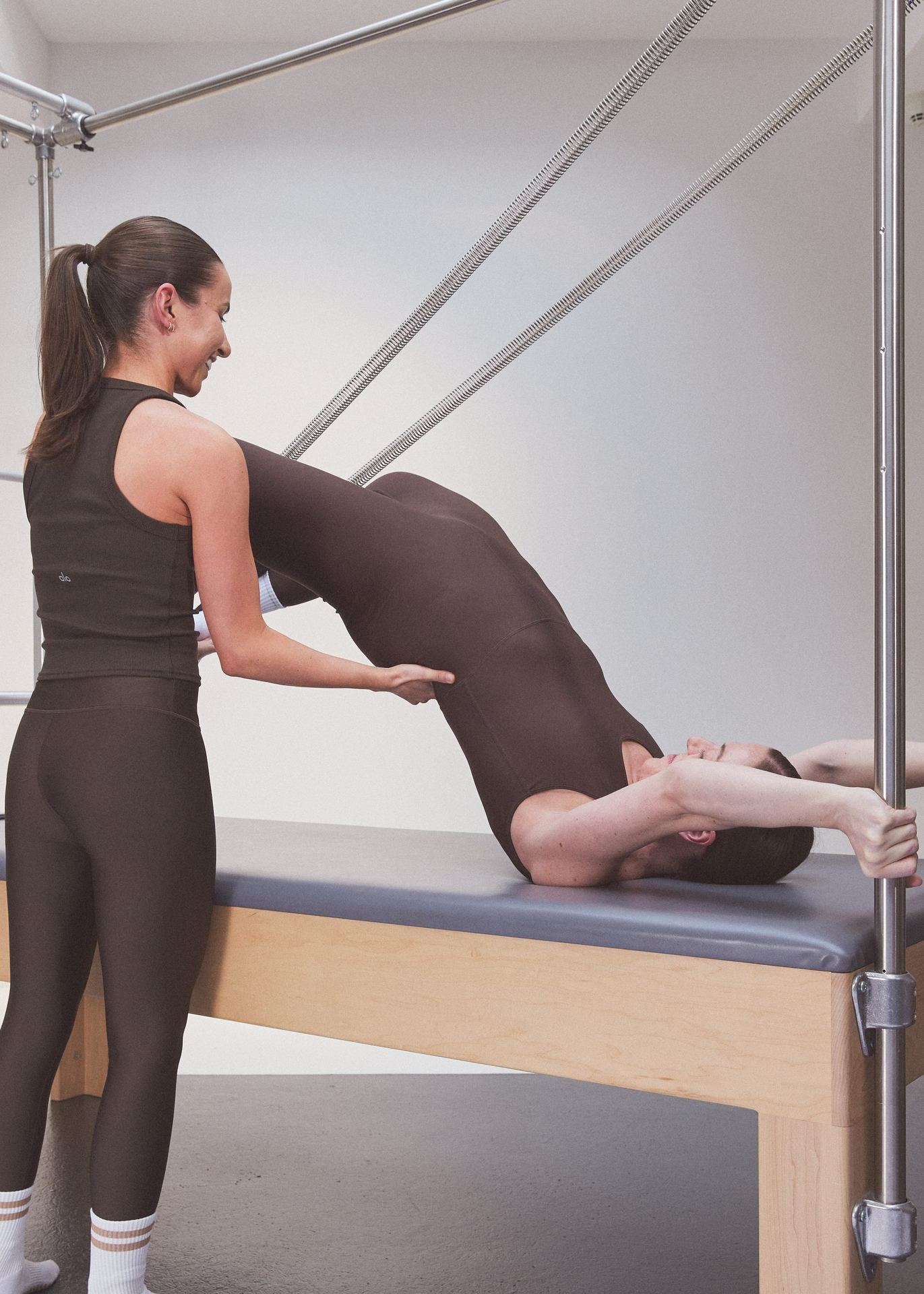
Therapeutic private sessions are built around a specific injury or pathology. You’ll leave with real postural awareness and practical strategies for moving safely and efficiently in daily life. The Reformer and other apparatus become precision tools—isolating joint stability or restoring mobility through targeted progressions and hands-on feedback.
- Individualized assessment and goal‑driven programming
- Movement education you can apply every day
- Equipment‑guided exercises to build stability or improve range of motion
Last updated
How Pilates Supports Movement Rehabilitation
Movement rehabilitation isn’t about pushing through pain—it’s about rebuilding the body’s fundamentals: control, alignment, and awareness. Pilates works from the ground up, retraining posture, joint stability, and safe movement patterns before ever asking the body to move against resistance.
By prioritizing stability and alignment first, rehabilitation sessions protect vulnerable joints while restoring confidence in movement. The apparatus provides precise feedback and gentle assistance, helping your instructor find a safe range where deep stabilizers activate without provoking symptoms, before gradually introducing challenge.
We work alongside your medical team. Pilates here is movement re-education by a certified instructor, not a medical treatment, bring your physiotherapist’s guidance and we will build around it.
What conditions do you work with?
MTLPILATES works with clients living with osteopenia and osteoporosis, stenosis, spondylolisthesis, hip replacement and hernias, with prenatal and postnatal clients, and with post-surgical rehabilitation of the knee, shoulder and spine. Every one of them starts privately, with clearance from a physician or physiotherapist.
- Osteopenia and osteoporosis
- Stenosis
- Spondylolisthesis
- Hip replacement
- Hernias
- Prenatal and postnatal
- Post-surgical knee
- Post-surgical shoulder
- Post-surgical spine
During pregnancy, we strongly recommend private lessons or duos. Small group lessons are available upon request.
If your diagnosis is not on this list, ask rather than assume. The answer depends on what your clinician has cleared and on your own history, not on a category. And the boundary does not move: this is supervised movement re-education that complements physiotherapy and medical care. It does not replace either of them, and no session here treats the condition itself.
Do I need clearance from a doctor before starting?
Yes. Clearance from your physician or physiotherapist is required before your first rehabilitation session. This is a requirement, not a suggestion. Tell us your diagnosis and bring your clinician's guidance when you book, and the instructor will build the session inside the limits they have set.
We would rather delay a first session than run one blind. If you do not have clearance yet, book the conversation instead of the session, call the studio, describe where you are, and we will tell you what to ask your clinician for.
What a first rehab session looks like
- 01
Clearance & history
We confirm the clearance from your physician or physiotherapist, then review your diagnosis, your history and what you want to get back to.
- 02
Assessment
A gentle movement assessment on the apparatus to find safe, strong ranges to start from.
- 03
Adapted work
Spring-supported exercises tailored to your condition, with constant feedback and hands-on cueing.
- 04
A plan
A progression you can build on, and a recommendation for how often to train to see change.
Why start with private sessions?
A private-first pathway lets the instructor tailor every exercise to your body before you ever join a group. For rehabilitation, that individual supervision is the point, it is what makes the work both safe and effective.
Many clients move into small group classes once they have rebuilt a base, keeping a periodic private to progress safely. During pregnancy, we strongly recommend private lessons or duos, with small group lessons available upon request. First-time clients can begin with three private sessions for $225.
Do you work with athletes?
Yes. The studio has worked with professional football players, Olympic divers, synchronized swimmers and skiers, professional dancers, ice skaters, golfers, tennis players and basketball players. The pathway is the same one rehabilitation uses: private sessions on the full apparatus, adapted to one body and one sport.
We do not name clients. What an athlete comes for is what a rehabilitation client comes for, springs that can load or offload a joint by degrees, and an instructor watching one body instead of a room. Whether you are coming back from an injury or building for the next season, the first session is the same private assessment.
Good to know
Rehabilitation questions
What are the benefits of Pilates?
Pilates improves posture by strengthening the deep core and spinal muscles, enhancing alignment and body awareness, increasing flexibility and spinal mobility, reducing neck and back pain and injury risk, and improving balance for everyday tasks. Most clinical programs showing measurable gains run 6 to 12 weeks with 2 to 3 supervised sessions per week.
Start with a private assessment.
Three private sessions for $225, adapted to your body from the first minute. Tell us your diagnosis when you book, and bring the clearance from your physician or physiotherapist.